
What we do
Animal Protection 2.0
Like everything else, animal welfare must evolve with the times. While just a few years ago our mission consisted mainly of intervening when an animal was in distress, prevention and raising awareness have now become top priorities. More information and more options: what seems positive at first glance also has its pitfalls. Any prospective pet owner can form an opinion online and on social media, or find arguments there to support their viewpoint. However, it’s important to approach content shared on social media with a critical eye and to question the motives of certain “experts” and so-called animal lovers.
We aim to raise awareness among children and teenagers about animal welfare from a young age and give them an insight into our work; we also regularly offer training sessions for adults.
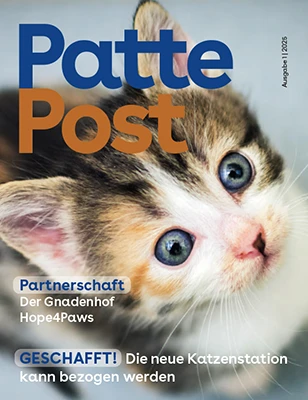
PattePost
In our PattePost, we cover a variety of topics. Whether we’re providing a glimpse into daily life at the shelter, offering dog-training tips, sharing success stories, or discussing animal welfare issues in general, each issue helps to advance modern animal welfare.
From selecting topics to layout design, right through to the print-ready file, everything is handled by the Luxembourg Animal Protection League. A big thank you to our staff, who play an essential role in the success of this project.
Want to take a look? Click here to access the PattePost
Campaigns
The 2025 kitten season turned out to be one of the busiest periods in the animal shelter’s history. With the number of cats at the shelter at times exceeding 100, it became clear that even our expanded capacity was not enough to effectively combat the annual overpopulation.
We frequently receive reports of stray, pregnant cats as well as orphaned kittens. To tackle this issue at its source, on February 2, 2026, we launched a national awareness campaign on cat ownership. Under the slogan “Spay. Microchip. Register.”, cat owners were made aware of the three essential pillars of responsible pet ownership.
The importance of identification and registration is clear: a found animal can only be reunited with its owner if it is microchipped and properly registered in a database. The “Déierenasyl” shelter takes in about 300 found cats each year, but only about 15% of them are reunited with their owners.
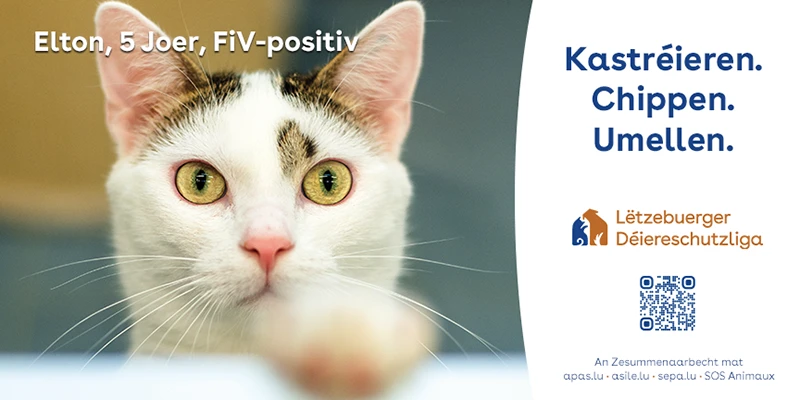
The campaign focused primarily on promoting spaying and neutering. A high proportion of unspayed or unneutered free-roaming cats, as well as feral cat populations, leads to exponential population growth within just a few years. To effectively curb this phenomenon, it is therefore necessary to significantly increase the spay/neuter rate. To encourage cat owners to participate, we covered a portion of the surgery costs.
For feral or stray animals, additional resources were put in place to capture them, spay or neuter them, and release them back into the wild after a short recovery period. The associated costs were fully covered by the Lëtzebuerger Déiereschutzliga through June 30, 2026.
In total, nearly 700 cats were spayed or neutered as part of this campaign.
The campaign was promoted through numerous channels, including print media, digital billboards in shopping centers and at bus stops, RTL’s online portals, and advertising space on the backs of certain TICE buses.
At the same time, the groundwork was laid for a collaboration with the animal shelters apas.lu (Schifflange), asile.lu (Dudelange), and sepa.lu (Esch).
Other campaigns are currently in the works.
Annual Report
Would you like to learn more about our specific activities? Then read our annual report